5RPS Full Movie Screenplay Completed: The Human Thinks, the Agents Execute
We have successfully completed writing the full-length film screenplay.
These are the events that followed the release of the 5 Requests Per Second trailer.
Over the last several months, we finished the screenplay for 5 Requests Per Second twice in two very different ways.
The first pass was manual and rough. We wrote scenes, moved through the acts, and tried to solve the film directly on the page. Each scene took a long time. The 5rps-seisaku production repository started in March after migrating from writing the screenplay in Notion, and by early April it records a complete screenplay pass followed by our manual updates.
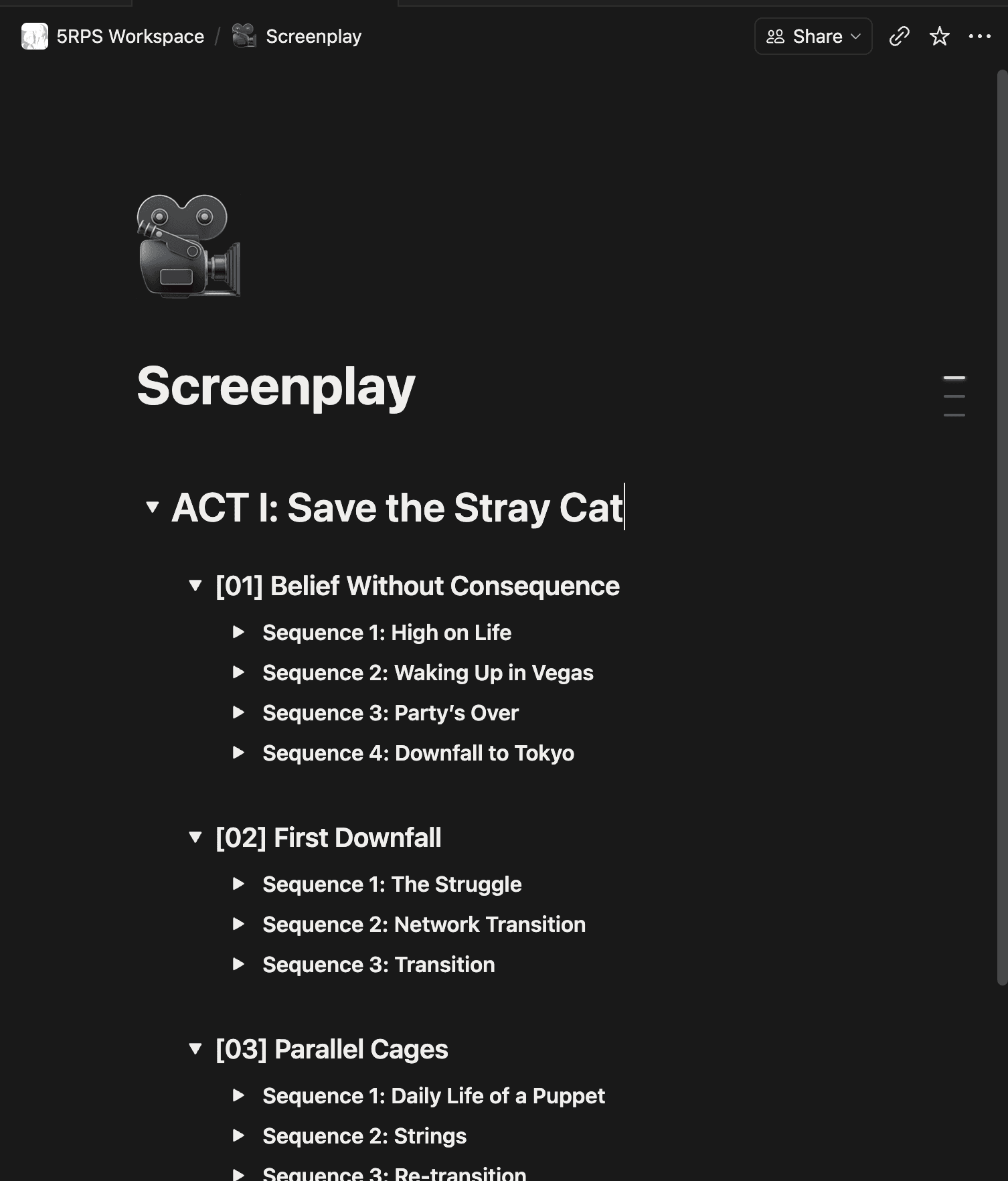
The first manual screenplay pass, organized in Notion.
Learning how much belongs on the page
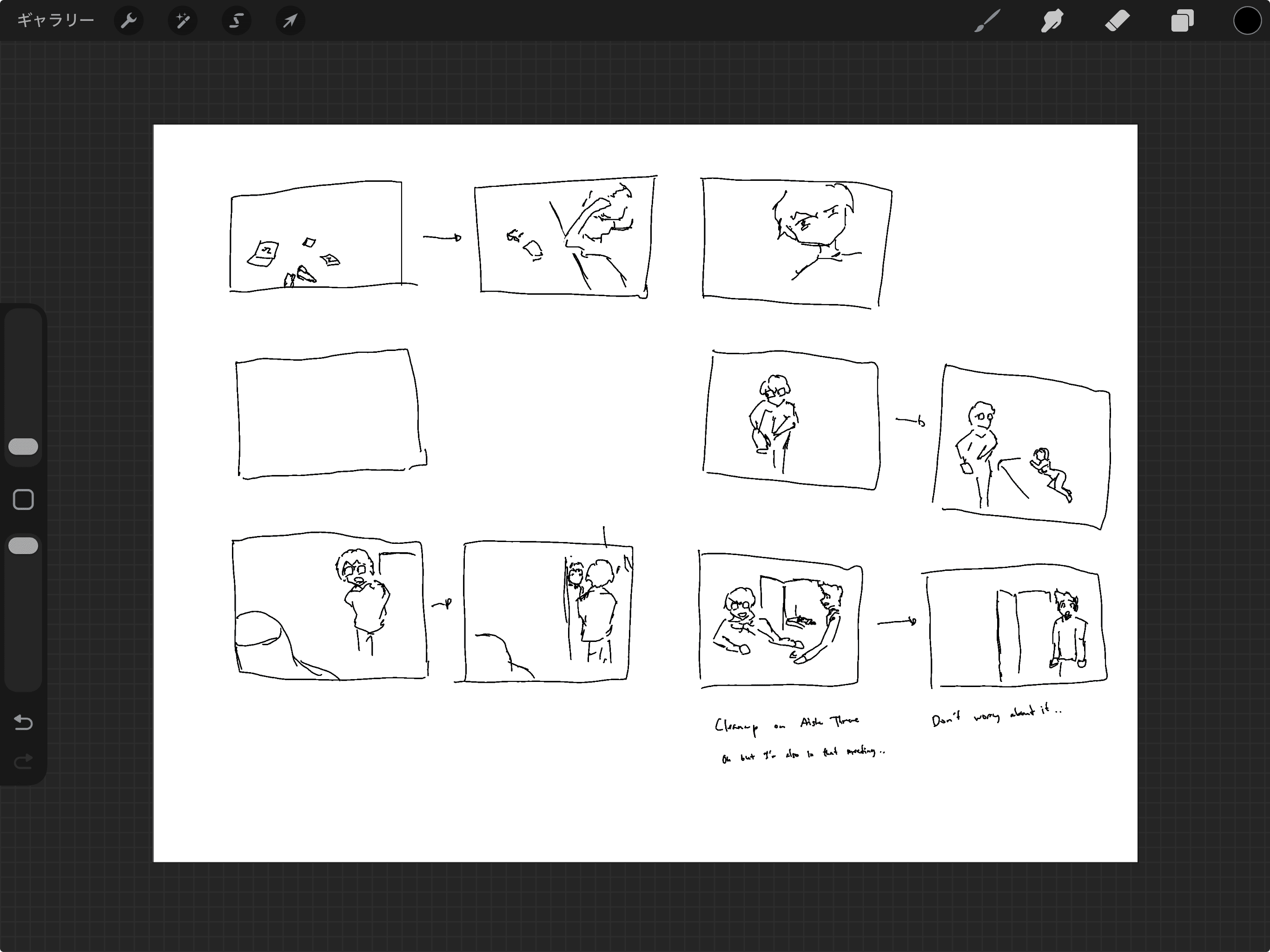
Coming from animation, one of the harder adjustments was learning how much visual detail belongs in a screenplay. Before this film, an idea could move more directly into storyboards and an animatic. Camera position, timing, body language, and the order of visual information could be worked out in images.
A screenplay introduces another layer. If the writing is too sparse, the visual intention disappears before storyboarding begins. If every image is specified, the page becomes heavy and starts doing the storyboard's job too early.
The revision below shows that tension. A short action paragraph became a much more detailed description of the office gates, the objects a character is carrying, foreground and background positions, reflected glass, changing light, and the next reveal. Much of that information is useful for animation. The question is how much the reader needs now, and what should remain open until the storyboard and animatic.
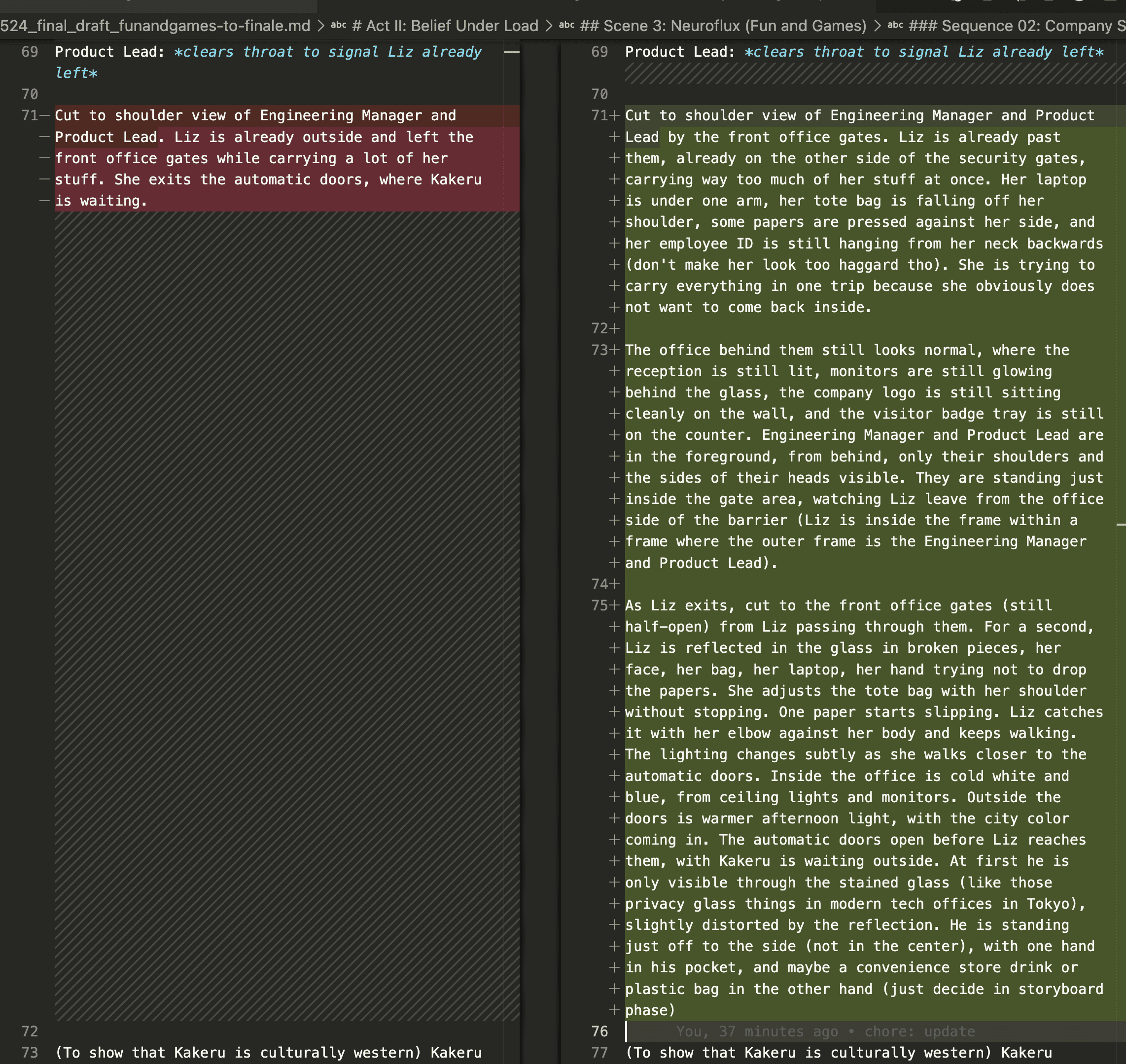
Working out how much visual direction belongs in the screenplay and how much should wait for storyboarding.
Then, as the engineers we are, we attempted making use of our harness engineering "expertise" from our day jobs to create a much more agentic process. We built a harness and wrote prompts for different agents, giving them separate jobs across the screenplay.
We first wrote the elaborate per-act/per-scene/per-sequence instructions and used agents to critique scenes, rewrite sequences, compress the screenplay, regenerate storyboard material, and run repeated passes across the whole film. The git history has been quite honest about this period. Between late April and the middle of May, the history fills with revisions, restorations, critiques, dialogue fixes, storyboard regeneration, and another attempt to push the screenplay toward a numerical review score.
The agents could cover a lot of ground. They could keep track of files, apply formatting rules, compare versions, and make hundreds of small changes without getting tired. The result didn't click with how we wanted the movie to be. The screenplay had started to lose the things that were hardest to encode in a prompt: why a beat belonged in the film, how long a moment needed to sit, and whether a line sounded true when spoken by a person. In addition, the AI slop writing is real. It may just be our own experience but it could never capture personal experiences, film we've watched and how we interpreted them, and how we want to portray certain emotions or tension points or whatever we imagine onto the agent prompts, no matter how detailed we write them. It got to the point where we would go "we could have just written it by hand".
As a result, we reverted all of the agent-driven screenplay changes.
The commits record several of the reversals and restorations: an auto-rendered storyboard README, an Act II pressure pass, an Act II storyboard regeneration, and a heart-to-heart scene restored for manual rewriting. Returning the screenplay to our own process still required another full read. We had to decide what the film wanted scene by scene and rewrite it again.
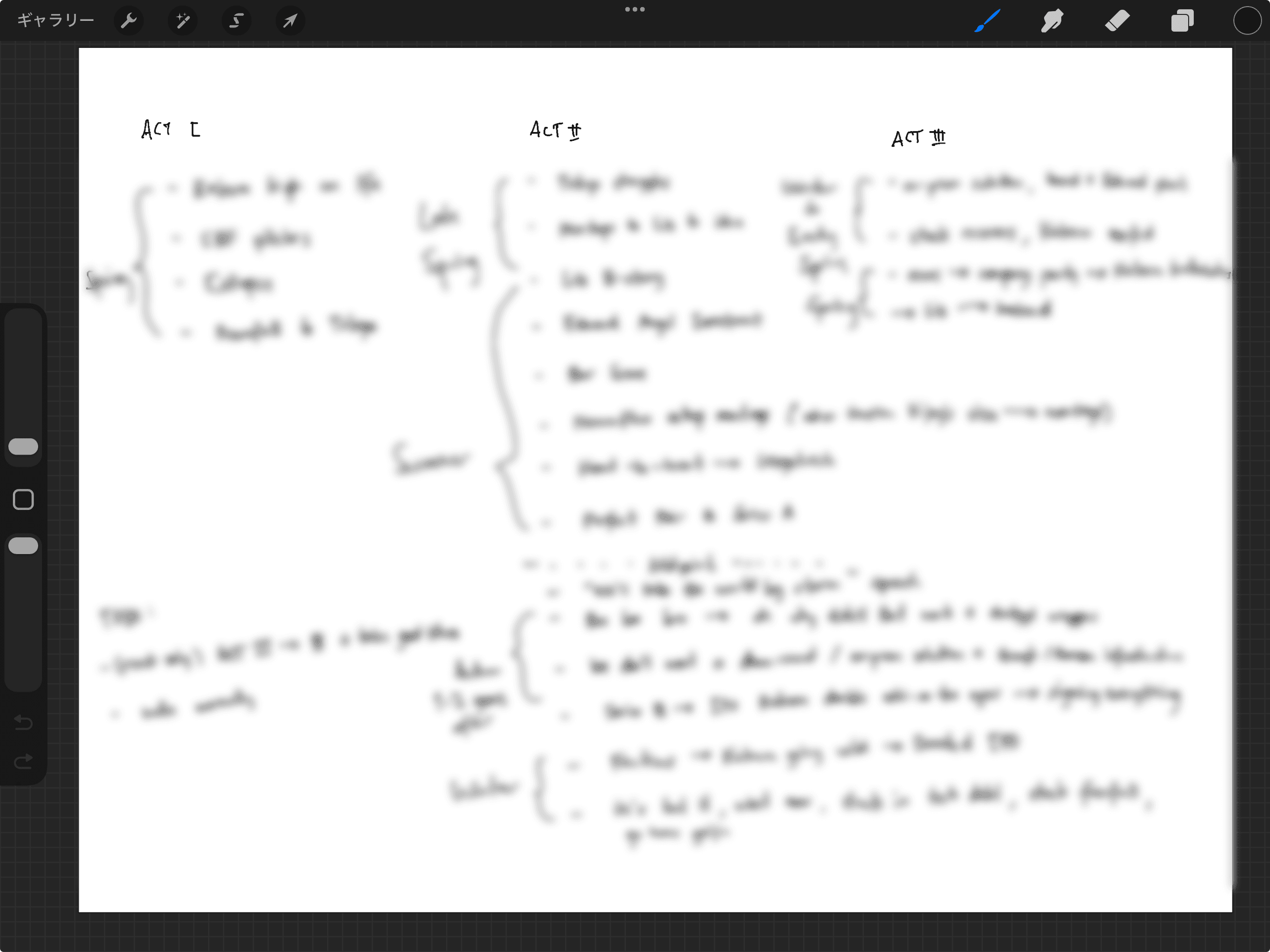
Reworking the film across all three acts in Procreate. Plot details have been blurred.
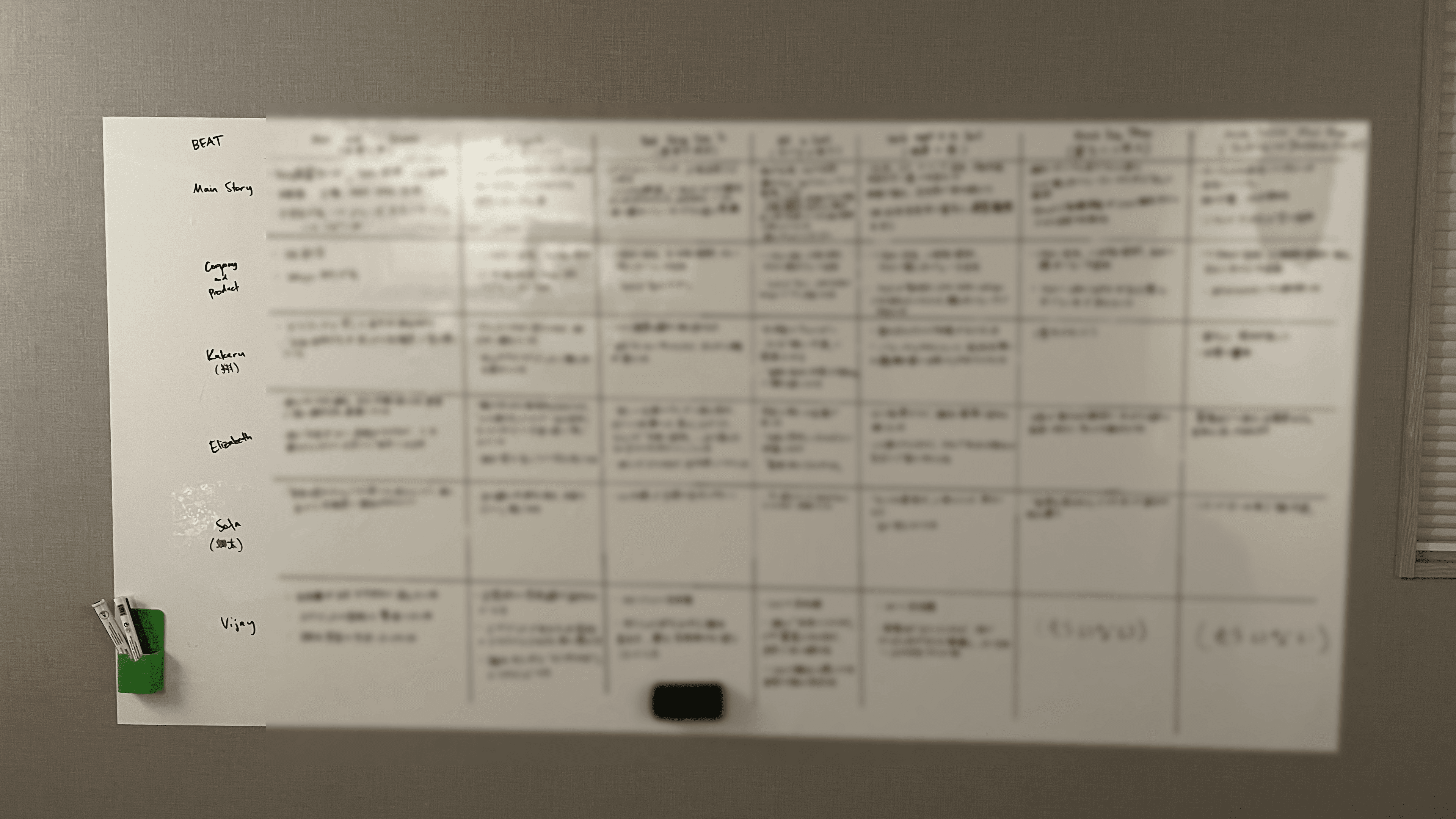
The working board for Acts II and III. Plot details have been blurred.
Building a review surface around the screenplay
The review app helped a lot during this pass. We wanted to read the film as a whole, leave precise comments, and move between the screenplay and its storyboard frames without flattening everything into one enormous document.
To make that possible, we reorganized the production source into a directory structure the app could load directly:
02_screenplay_storyboards/
├── act-01-<act-slug>/
│   ├── 01_act_summary.md
│   └── scene-01-<scene-slug>/
│       ├── 01_scene_summary.md
│       └── sequence-01-<sequence-slug>/
│           ├── screenplay.md
│           ├── storyboards/
│           │   ├── act1_scene1_sequence1_1.png
│           │   └── act1_scene1_sequence1_2.png
│           └── char/
│               └── <character-reference>.png
The folder names carry the ordering. The app scans each act-* directory with an act summary, then each scene-* directory with a scene summary, and finally every sequence-* directory containing screenplay.md. It parses the screenplay into reviewable blocks such as action, dialogue, sluglines, and transitions. Storyboard images stay beside their sequence and appear inline in the same review surface.
Comments are stored separately from the screenplay. A text comment records the source path, selected text, its occurrence, and a small amount of surrounding context. A storyboard comment points to the source file and image path. That meant we could rebuild the review view from the canonical folders while preserving a precise record of what we wanted to revisit.
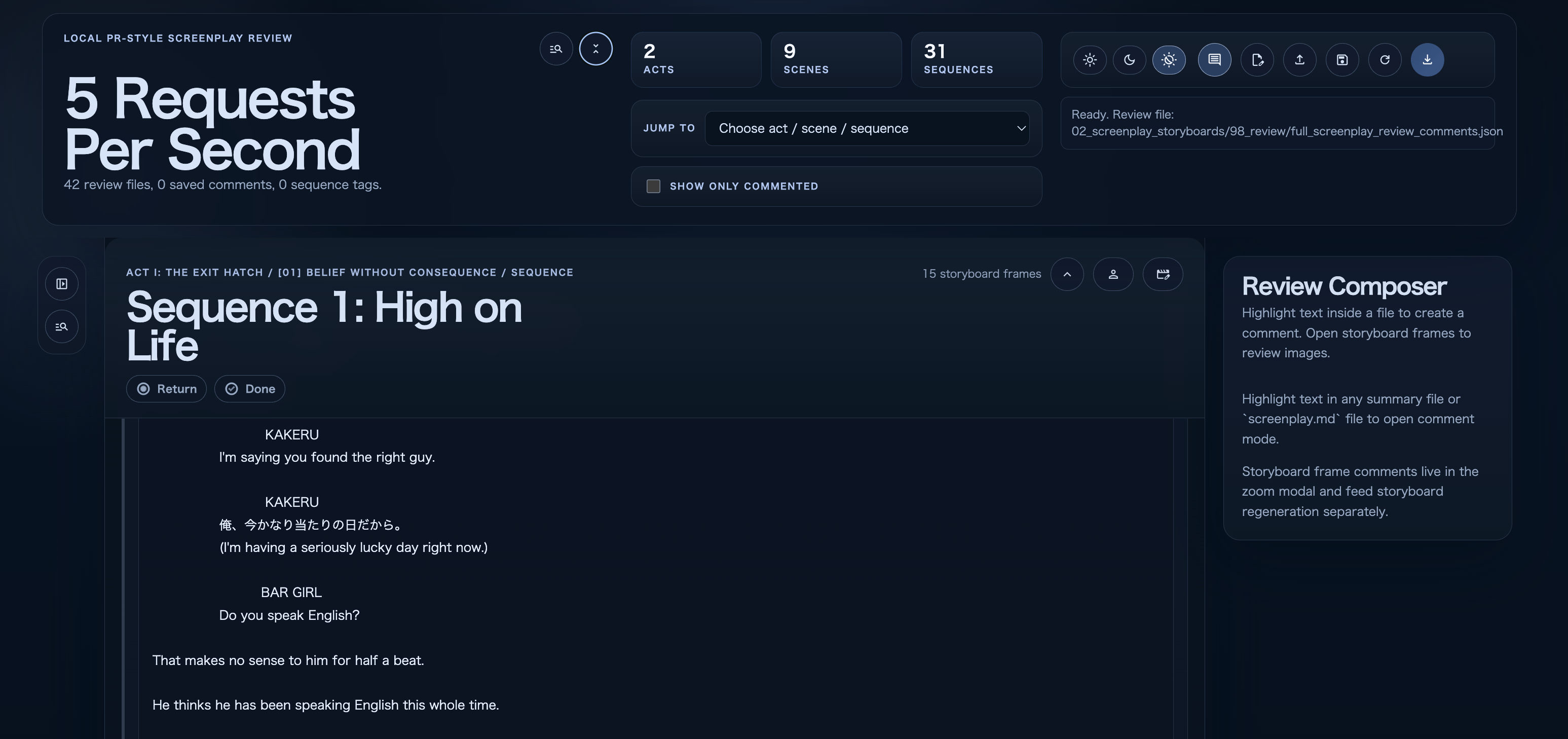
The local review app loads the screenplay and sequence-local storyboards from the same source tree.
The later history changes character. Commit messages start saying things like “remove AI slop,” “human think, AI do,” “restore heart-to-heart for manual rewrite,” and “ban vague timing aphorisms.” And yes, that commit from Codex taught us about the word "aphorism".
Those labels are blunt, but they describe the correction accurately.
Codex has also been a huge part of the process for research. We still use agents for that work, as well as assembling screenplay files, enforcing formatting, updating summaries, rendering documents, checking continuity, and flagging mechanical problems. We make the story decisions and write the scenes.
That boundary took months to find. Agentic tools became most useful once we stopped asking them to supply the reason a scene should exist. They are good production executors when the direction is already clear. When we handed over the direction itself, we got more pages and less of the film we wanted to show.
The screenplay is now complete. The next step is storyboarding, where we will carry forward the principle we developed during this process: the human thinks, the agents execute. However, it most likely will be manual drafting while being assisted by the agents for finding good film clips to watch, books to read, or compositions to refer to, as well as continuously improving our production platform.
We look forward to sharing regular updates from now, as it is easier to share more visual things without spoilers than in the screenplay writing stage.
Join us in the 5 Requests Per Second Discord to follow the production and continue the conversation.